
SAP MM certification C_TS452 exam structure: before you step into the practice kitchen
Part 1 of my SAP MM certification (C_TS452) series: getting eligibility and a practice system through Learning Hub, how the hands-on SyBA exam works, and why a PP practitioner started with MM.
Hi, this is Rabbit! 🐰
At culinary school, you can pass the written exam by memorizing recipes. The practical exam is different. You have a fixed amount of time, a set of ingredients, and you have to produce the dish exactly as the recipe says. If the seasoning is even slightly off, you lose points.
The SAP MM certification, C_TS452, is exactly this kind of practical exam. I took it three times: 31%, 25%, and then 97%. In the SAP certification guide I explained how to read the certification menu, and in SAP certification exams I described the new exam room. This series is the record of actually walking into that room. Part 1 covers what I prepared before the exam and what kind of exam I faced.
Three-line summary
- The SAP MM certification (C_TS452) covers S/4HANA sourcing and procurement, and it is a SyBA exam where you complete tasks in a real system.
- I got eligibility and a practice system through an SAP Learning Hub subscription supported by my company, and planned to use its four exam attempts for MM, PP, and CO.
- I picked MM first because it has less material than PP and connects to PP through MRP.
What the SAP MM certification C_TS452 covers
The official name is SAP Certified - SAP S/4HANA Cloud Private Edition, Sourcing and Procurement, usually called the SAP MM certification. The number after the code is the exam version. Mine was C_TS452_2601.
In restaurant terms, the exam covers everything about buying ingredients and running the storeroom.
- Organizational structure: plants, storage locations, purchasing organizations. The floor plan of the restaurant, storeroom, and purchasing team
- Master data: materials, suppliers, purchasing info records. The ingredient list and the supplier ledger
- Purchasing process: the flow of order documents from purchase requisition → purchase order → goods receipt → invoice verification
- Source determination and contracts: the rules for which supplier to buy from, and on what terms
- Inventory management and valuation: deciding what the ingredients that arrived are worth in the books
The study material is all on SAP Learning Hub. The training courses for this certification are split by area, such as S4500, S4510, and S4550, and if you search Learning Hub for the certification name or code, it clearly lists which courses to take. The exam scope is almost identical to the scope of those courses.
Eligibility and a practice system through Learning Hub
The SAP certification guide listed four ways to become eligible for the exam. I chose an SAP Learning Hub subscription. It is not a small cost to cover on your own, and fortunately my company supported it.
Learning Hub matters for a hands-on exam for three reasons.
- Practice system: it includes a practice system that is almost the same as the exam environment. For a hands-on exam, this is practically everything.
- Exam attempts included: four exam attempts come with the subscription period.
- Tied to renewal: you need the subscription for Stay Certified after passing anyway. Earning the certification and keeping it come out of the same wallet.
The practice system mattered especially to me. At work I had only ever used SAP GUI, so I had barely touched Fiori (SAP’s web-based interface). The exam uses Fiori apps and GUI transactions together, and spending several minutes hunting for one screen turns straight into lost points. I needed an environment where I could freely click through screens I could not practice on at work.
Four attempts, a three-certification plan
Four attempts means you need a plan. I picked three certifications I definitely wanted.
| Order | Certification | Area |
|---|---|---|
| 1 | C_TS452 (MM) | Sourcing and procurement |
| 2 | C_TS422 (PP) | Production planning |
| 3 | C_TS4CO (CO) | Management accounting |
Table 1. Certification plan built around four exam attempts
Three must-have exams and four attempts left exactly one spare. How quickly that spare can disappear is a story for the next parts.
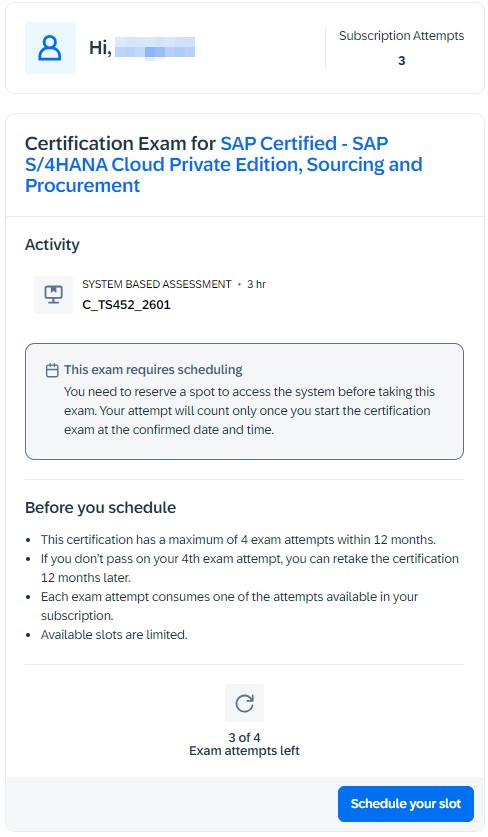 Figure 1. Certification Hub after my first attempt. You can take the same certification up to four times within 12 months.
Booking a slot does not use up an attempt. One attempt is deducted the moment you start the exam at the confirmed date and time. Slots are limited, though, so it is safer to match your number of exams to your number of attempts before you schedule.
How the C_TS452 SyBA exam actually works
Of the two exam types introduced in SAP certification exams, C_TS452 is a system-based assessment (SyBA). There are no multiple-choice questions. You log in to a real S/4HANA system, complete the assigned tasks, and a backend script grades the results.
This is what it was like in practice.
- Environment: you log in to S/4HANA with an exam user ID and use the Fiori launchpad and SAP GUI transactions together.
- Structure: a few large tasks, each followed by a chain of sub-exercises. Later steps use data created in earlier ones, so one mistake early on brings down everything after it.
- Time: 3 hours. It sounds generous, but divided across the sub-exercises it is tighter than it looks.
- Grading: it does not check whether you reached the last screen, but whether the saved values match the instructions exactly. One wrong quantity or date means zero points.
- Instruction language: you can choose the language of the instructions at the start. That choice changed my result a lot, which I cover in the review of my first attempt.
⚠️ Caution: the
Confirm completionbutton at the bottom submits the entire exam, not a single task. Press it only at the very end, after finishing every exercise.
Why a PP practitioner started with MM
I work on the production (PP) side. Yet I chose MM as my first certification, for practical reasons.
First, the amount of material. Compared with PP, MM has less course content and fewer processes to cover. Since I also had to get used to the hands-on format itself, a narrower scope seemed better for a first attempt.
Second, my day-job advantage was smaller than it looks. A system-based exam runs on SAP standard transactions and standard processes, not on each company’s own screens. I was used to my company’s CBO programs, so even if I took PP first, I would still have had to learn the standard screens from scratch, just as with MM. My work habits could even clash with the standard procedure.
Third, MRP as the link. In SAP certification vs. CPIM I talked about the “why” of PP, and the better you understand production planning, the less you can avoid MM. Running MRP creates purchase requisitions, and MM’s source determination decides which supplier each requisition goes to and on what terms. The plan for how many dishes to make today becomes the ingredient order. I expected that learning MM first would make the flow after MRP feel familiar in the PP exam too.
Rabbit’s Takeaway
In SAP certification exams I wrote that the exam now rewards people who have actually done the work. Taking it showed me one more thing. You have to follow the instructions, not the way you usually do it. The longer you have worked, the more you trust your own touch over the recipe, but this exam grades the recipe, not your touch 😎
Read more