
SAP MM certification C_TS452 practice strategy: the same dish, faster and more precisely
How I practiced for my SAP MM certification (C_TS452) retake: switching to English course material, a three-stage practice plan, the 3-minute check, checking before every save, and working on a shared practice system.
Hi, this is Rabbit! 🐰
The junior cook in a busy restaurant does not repeat the same dish hundreds of times because they don’t know the recipe. They do it so that when the lunch rush hits, they can still plate the right amount within the time. Making a dish you already know quickly and precisely is a skill you have to practice on its own.
After my first attempt failed, I reached the same conclusion. I had most of the knowledge. What I lacked was the ability to execute precisely and on time. So my plan for retaking the SAP MM certification C_TS452 was not “study more” but “do the same things more precisely and faster.”
Three-line summary
- I kept learning concepts in Korean, but switched all screen work and instruction reading to English.
- I designed practice in three stages (learn the screens → hit the time → full rehearsal) and got a 3-hour practice set down to about 100 minutes.
- I built execution rules such as the 3-minute check, checking before saving, and verifying checkpoints right away, and drilled them into practice.
I switched all study material to English
Before my first attempt, I went through the Learning Hub courses from Part 1 mainly to understand the concepts in Korean. From the retake onward, I changed the rule.
- Concepts in Korean, but
- Screen work, field names, and reading instructions in English
Repeating the course exercises in English builds two things at once: an eye that links the field names on screen directly to the words in the instructions, and the habit of reading every instruction to the last word. In a hands-on exam you have to enter the values written in the instructions you were just given, not the values your hands are used to. Without that habit, you end up typing familiar values without thinking.
Designing C_TS452 practice in three stages
My practice material, from start to finish, was the exercises in the Learning Hub courses. There were a lot of them, so I had an AI organize the course outlines and each course’s learning objectives, and used that to pick out the core exercises I needed to master in each course. I then repeated those exercises with a different goal at each stage.
| Stage | Goal | Method | Pass criteria |
|---|---|---|---|
| R1 Learn the screens | Complete every course exercise once | No time limit; dig into anything unclear | All done + list of screens where I got stuck |
| R2 Hit the time | Meet a target time per area | 3-minute check, mandatory check before saving | Finish within target time |
| R3 Full rehearsal | Bundle exercises into a 3-hour set, run like an exam | 3 hours straight, spare time for full verification | Finish on time + verify |
Table 1. Three-stage practice plan
The first time I timed a full run in R2, I was 17 minutes over target. Breaking it down by area, most of the overrun came from configuration (Customizing), my weakest area. I rarely did it hands-on at work, so I repeated just the course exercises for that area. By R3 I could finish the 3-hour practice set in about 100 minutes, and I spent all the remaining time on verification.
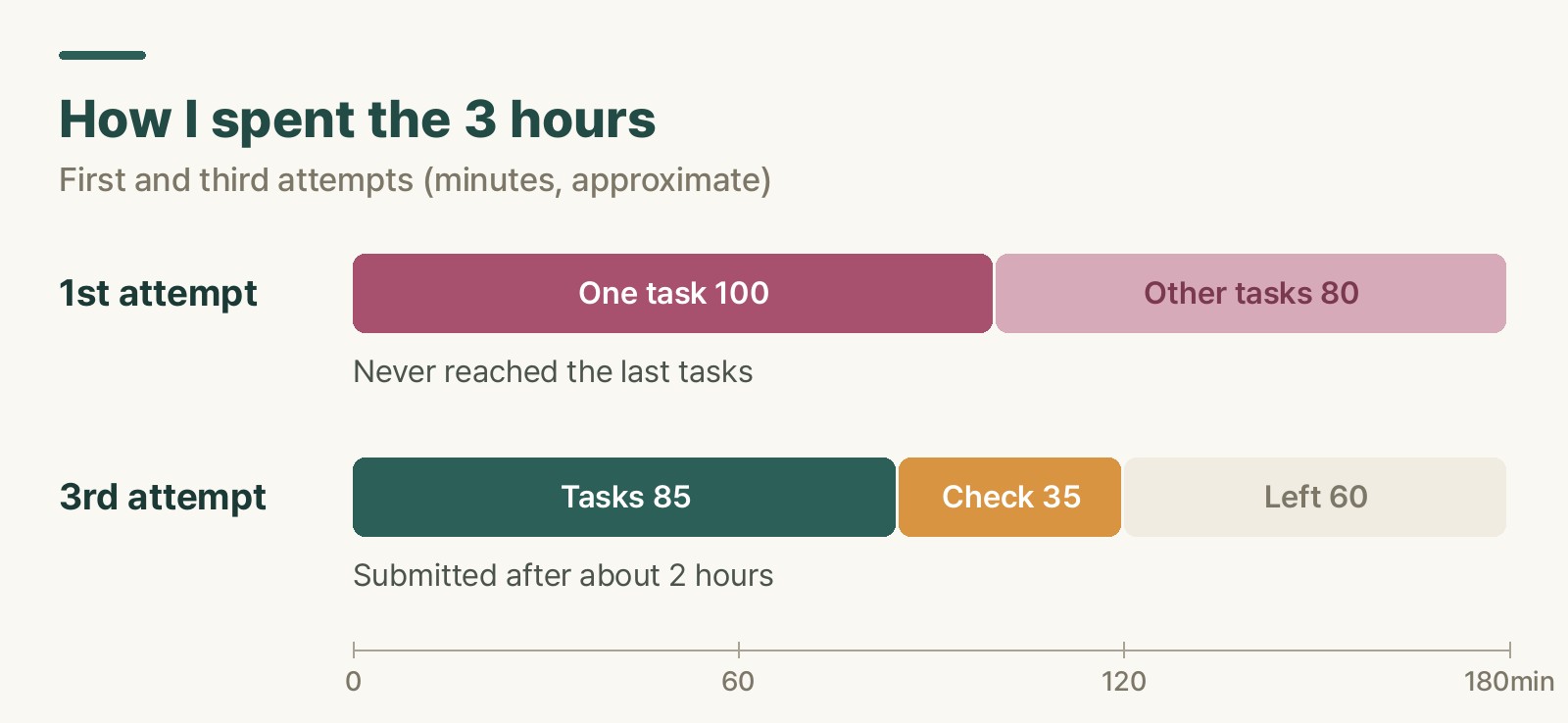 Figure 1. Time allocation in the first attempt, the practice rehearsal, and the third attempt (minutes, approximate)
Five execution rules
These are the rules I built while practicing. I followed them throughout practice and worked in the same order in the exam.
- The 3-minute check: if I am stuck on one screen for more than 3 minutes, I stop and decide. If no later task depends on the item, I note its number and move on; if a later task uses its result, I reread the instructions from the top. I don’t skip blindly because the exam is a chain where later tasks use the output of earlier ones. I collected every screen that took more than 3 minutes and drilled it separately, so in the actual exam I hardly ever needed this rule.
- Check right before saving: before Save, I match each field in the instructions with the value on screen, one to one. Especially the number of digits.
- Verify checkpoints right away: wherever an object is created or a document number is generated, I open the display screen right after saving to confirm it. In practice alone, a single checkbox that did not save threw off an entire later task twice.
- Don’t touch values the instructions don’t mention: “improving” a value the system proposed, such as a delivery date, is a waste of time. What gets graded is the values written in the instructions.
- Open the transaction fresh every time: if you use the same transaction back to back, values you just entered (such as the movement type) can stay behind. The single habit of fully exiting and re-entering prevented mistakes.
Things to watch on the shared practice system
The Learning Hub practice system is a server shared by learners around the world. It is very close to the exam environment, but sharing one kitchen with many people causes some problems.
- Names collide: sometimes the code I wanted to create already existed because someone else made it. I changed the code prefix for each round (for example Y0 → Y1 → Y2) to avoid collisions.
- Settings change: once, someone had changed a system setting, so it behaved differently from the course material. When that happens, the first step is to separate my own mistake from an environment problem.
- Dates follow the server: the server runs on German time, so practicing in the early morning in Korea puts “today” a day off. Tasks involving dates have to be calculated with the system date.
Doubt your practice notes too
I kept detailed practice notes, but once a note itself was wrong and caused an error. It was a note I had written from the screen alone, with no backing from the course material, saying “this field cannot be changed.” In fact it could be changed, and it actually had to be left in that state.
After that, I graded my notes. I separated what I had confirmed in the course material from what I had guessed from the screen, and treated negative notes like “you can’t do X” as items to recheck. In the end, what protected me in the exam was not how accurate my notes were, but rule 3: verifying checkpoints right away.
Reference material during the exam
The SyBA exam felt close to open book, in that searching the internet was possible. Thanks to steady practice I never got badly stuck, but when a menu path was confusing I did look up public material.
AI tools and screen captures are a different matter. Communities such as Reddit are divided on whether they are allowed, and some say screen captures are detected. Above all, this exam exists to check whether you can operate the system yourself. In the end, the only thing you can rely on in the exam room is the procedure your hands learned through practice.
Rabbit’s Takeaway
I did not greatly increase my study time for the retake. What I changed was the way I practiced. Once I practiced not “can I solve this” but “can I do this on time, exactly as instructed,” the score followed. There is a reason the junior cook repeats the same dish hundreds of times 😎
Read more