
SAP MM certification C_TS452 Q&A: what new kitchen hands ask most
Answers to the questions I get most about the SAP MM certification (C_TS452): study order, materials, how to practice, managing exam time, and how long it took.
Hi, this is Rabbit! 🐰
New hands in a kitchen tend to ask the same few things. What to learn first, and how much to practice. When someone who went first writes the answers down once, the next person loses less time.
After I posted my SAP MM certification C_TS452 exam review, I received similar questions by email several times. The questions fell into a few groups, so I am collecting the answers here.
Three-line summary
- C_TS452 is a hands-on exam in a real system, so the hard part is time and accuracy, not knowledge.
- The surest preparation is repeating the official Learning Hub exercises in the practice system, as one continuous flow.
- Practice volume matters more than years of SAP experience, and you can let go of the pressure to pass on the first try.
C_TS452 exam format and difficulty
How does the exam work, and how hard is it
It is not multiple choice. You log in to a real S/4HANA system and complete tasks yourself for about 3 hours (180 minutes). Each large task contains a series of sub-tasks, and the system grades the results automatically. I covered the format in the exam structure part.
If you have done enough of the exercises, no single task is hard. The real difficulty is time and accuracy. One wrong field makes the answer wrong, and because later steps in a task use the results of earlier ones, a single early mistake can take the following steps down with it.
Read every condition in the instructions to the end, too. Small phrases such as “from” versus “more than”, “additional”, or “each” change the value you need to enter.
Should I practice SAP GUI or Fiori
Both. The exam mixes the two. For example, you might do configuration in a GUI transaction and approve a purchase order in a Fiori app. If you have only used the GUI at work, set aside time to get comfortable with Fiori (SAP’s web-based screens).
What to study, and in what order
Which topics should I prepare
Based on the official courses, the scope looks like this. In restaurant terms, it covers the whole job of ordering ingredients, putting them in the storeroom, and matching the supplier’s bill.
- Master data: material master, business partner (supplier), purchasing info record, source list
- Purchasing: purchase requisitions, purchase orders, contracts, purchase order approval and output
- Inventory management: goods receipts, goods issues, transfer postings, reservations, quality inspection stock, subcontracting
- Invoice verification: supplier invoices, unplanned delivery costs, blocked invoices, tolerances
- Consumption-based planning: MRP, reorder point planning
- Basic settings: enterprise structure and organizational units
Three of these were especially hard for me.
- Basic settings: tasks where you create plants, purchasing organizations, and purchasing groups yourself and link them. At most companies, IMG (Customizing, the settings that define how the system behaves) is handled by consultants or the IT team, so I had never done it at work either. After my first attempt, this is where I spent the most time, and most business users will find it unfamiliar.
- Subcontracting: you need to understand how sending components to a supplier, receiving the finished product, and consuming the components you sent connect to each other. If you just follow the screens, it is easy to lose track of what gets processed at which step.
- MRP: you need to know how MRP type, lot size, reservations, and source assignment affect the result. Change one setting and the result can be completely different.
If I start from zero, what order works best
Following the course order is the most natural. First get the basic flow into your hands with purchasing (S4500), inventory management (S4510), and invoice verification (S4515): from the moment an order comes in until it is settled.
After that, spend most of your time on basic settings (S4550), subcontracting, and MRP. You can only see what changes in these three areas once the basic flow feels natural.
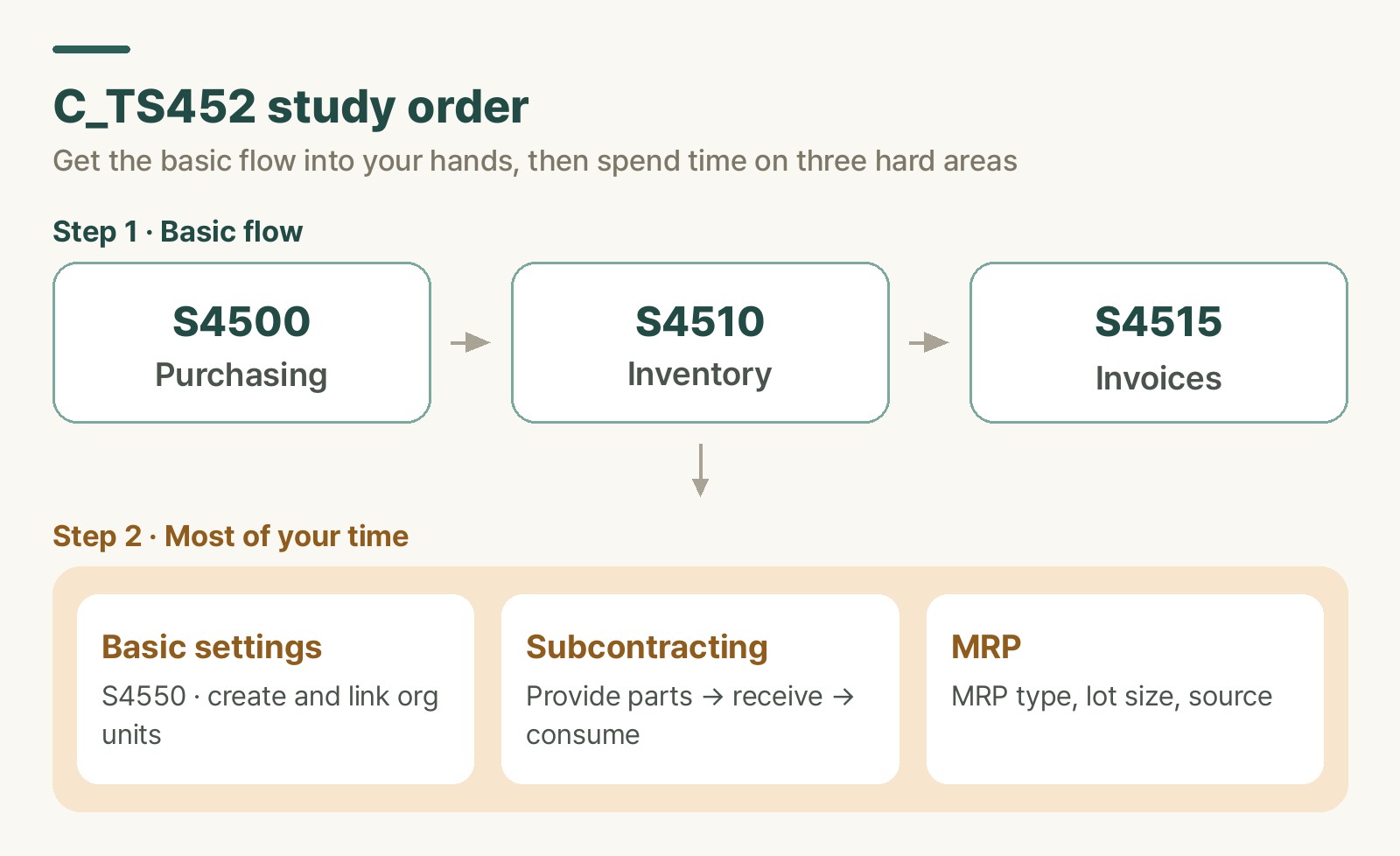 Figure 1. C_TS452 study order
What materials should I use
The official SAP Learning Hub courses are the core: S4500 (purchasing), S4510 (inventory management), S4515 (invoice verification), S4520 (advanced purchasing), S4525 (consumption-based planning), and S4550 (configuration). Every unit has exercises, and you can work through them yourself by connecting remotely to the Learning Hub practice system. The exam is set at almost the same level as these exercises.
So unless you have another way to use a practice system, I consider a Learning Hub subscription essentially required. It is paid, but it is worth the money. I covered subscriptions and exam eligibility in the SAP certification guide.
Courses such as those on Udemy are fine for getting the big picture, but they are not enough on their own. This exam looks at what you can do, not what you know.
How to practice
How should I work through the exercises
Instead of doing exercises one at a time, work through them as one continuous flow: purchase requisition → purchase order → goods receipt → invoice. That is how the exam is built. The materials, suppliers, and purchase orders you create in early steps are used as-is in later ones.
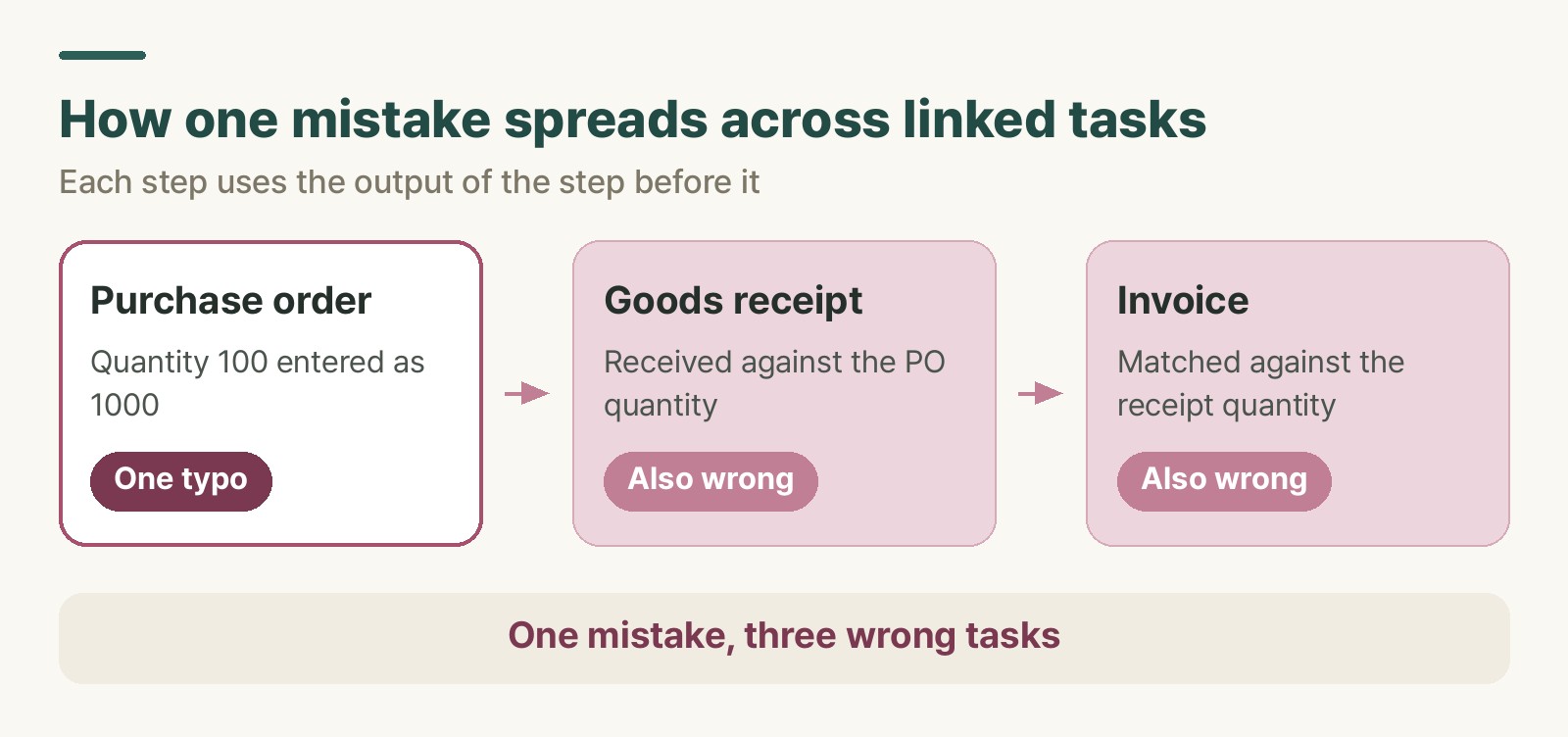 Figure 2. How one mistake spreads across linked tasks
Do each exercise at least twice, and do the second round without the solution. Where you get stuck following a solution is different from where you get stuck on your own.
While preparing, I often asked AI what an error message meant, why I got something wrong in practice, and why the system behaves the way it does. The exam had only recently become hands-on, and the Learning Hub material alone did not explain everything.
If you prepared again from scratch, what would you change
I took the first attempt too lightly. I got stuck on configuration tasks I had never done and spent more than half of the exam time on a single task, and about half of the tasks I did finish were wrong because of small mistakes such as mistyped numbers. It was less a lack of knowledge than a lack of checking. I wrote about this in detail in the first and second attempts part.
If I did it again, I would focus on the Learning Hub exercises rather than theory. C_TS452 does not test whether you know the theory. It tests whether you can complete the given tasks in SAP. What matters in the end is having the steps in your hands. If you want to study the theory in depth, I recommend CPIM over SAP certification. If CPIM is about understanding the “Why”, SAP certification is about learning the “How”.
A few habits that helped in the real exam:
- Before saving, compare every field with the instructions, one by one.
- After saving, open the record again in display mode to confirm.
- The system often proposes values from the previous step (storage location, movement type, and so on), so do not trust the defaults.
- Before the real exam, do at least one full 3-hour mock run with a timer.
C_TS452 exam day
How should I divide the exam time
Decide the task order after you receive the instructions. Finish the transaction tasks you are confident in first, and leave the time-consuming configuration tasks for later. If a task takes longer than expected, skip its remaining sub-tasks for now and move on. The steps that follow a skipped one stop with it, so come back and finish them if time allows.
And always leave time at the end to check your results. On my third attempt I spent about 85 minutes on the tasks and about 35 on a full verification. I described exam day in the practice and passing part.
Where can I take it, and can I use AI tools
You can take it on your own computer. I took my first attempt at a library and the second and third at home.
Whether you can use tools such as AI during the exam is not something I can answer. The rules can change at any time, so check SAP’s official guidance before your exam.
Study time and experience
How long did you study, and how many hours a day
It took about 2–3 months. On weekdays I studied for less than an hour whenever I had time, and on weekends I picked one day and put in 5–6 hours.
My day job is PP, so I had only seen MM from the side. Because the exam is hands-on, I spent most of my study time on practice.
Is it possible with only a little SAP experience
Yes. In this exam, practice volume decides the result more than years with SAP. If you can practice every day, a few months is enough.
I failed my first attempt, could not complete my second because of an exam system problem, and passed my third with 97.14%. You can let go of the pressure to pass on the first try.
Rabbit’s Takeaway
When I first failed, I wondered whether I had started too late. Looking back, the first failure showed me what I still needed to prepare. Almost every answer here ends up in the same place: repeat the exercises as one flow, until they are in your hands. Just as a new kitchen hand learns by cooking the same dish again and again, this exam rewards what stays in your hands 😎
Read more